
EPC C by 2030: What Oxfordshire Landlords Need to Know This Winter
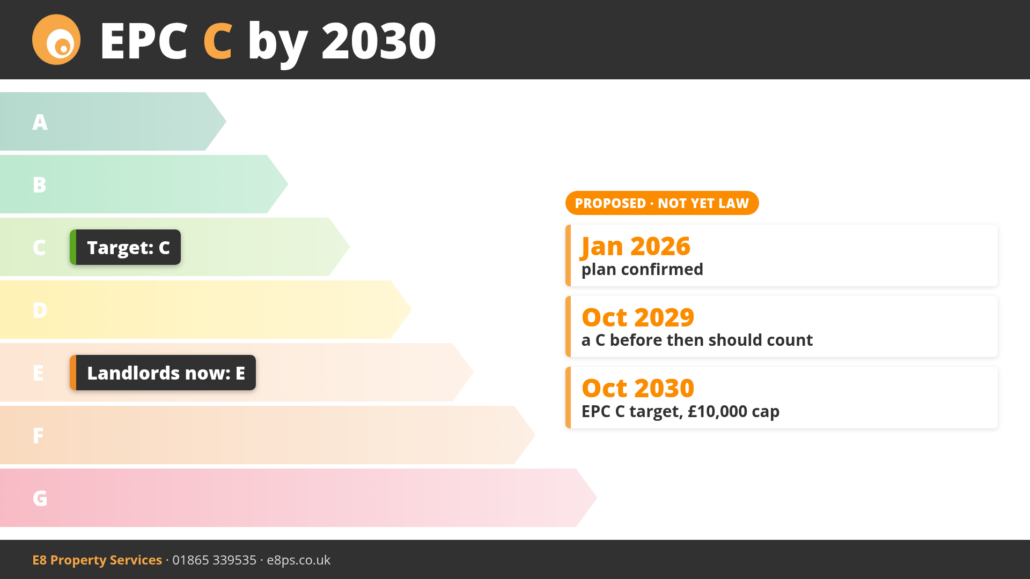
If you let a home in Oxfordshire, you will probably have heard that the energy efficiency rules for rented property are getting tougher. In January 2026 the government confirmed its plans, and with the heating season now under way it’s a good moment to look at where things stand, what has been decided, and what is still to come.
The rules today: EPC E
Under the current Minimum Energy Efficiency Standard (MEES), most privately rented homes in England and Wales need an EPC rating of at least E. Since 1 April 2020, landlords have not been able to let, or continue to let, a property covered by the regulations if it is rated F or G, unless a valid exemption is registered (GOV.UK).
The current cost cap means you are not required to spend more than £3,500 (including VAT) on improvements. If a property can’t reach E within that amount, you can register an exemption.
What’s changing: EPC C by 1 October 2030
On 22 January 2026 the government published its response to the consultation on improving the energy performance of privately rented homes. The headline decisions are:
- A single compliance date. All private tenancies in scope will need to meet the higher standard, broadly equivalent to EPC C, by 1 October 2030. There won’t be an earlier date for new tenancies.
- A higher cost cap. Landlords will be required to invest up to £10,000 per property. If a home still falls short after that, it can be registered for a “cost cap” exemption lasting 10 years.
- Lower caps for lower-value homes. For properties valued below £100,000, the maximum spend will be 10% of the property’s value.
- Credit for acting early. Once the new rules apply, spending on relevant improvements installed since 1 October 2025 can count towards the cap, as can the cost of the EPCs needed to show compliance.
- Short-term lets are not included for now.
Until the new standard applies, the existing EPC E rules continue.
It’s important to note that these changes are not yet law. The government has said it will bring in new powers through an Act of Parliament and aims to lay regulations to come into force in 2027.
A new way of measuring homes
The future standard will be judged using new EPC metrics, rather than the single energy cost rating used today. Landlords will first need to meet a fabric performance standard (think insulation and draught-proofing), and then a second standard based on either the heating system or “smart readiness”, whichever the landlord chooses.
Why your current EPC rating matters
The government has said that rented homes rated C or above on the current Energy Efficiency Rating before 1 October 2029 will be treated as compliant with the higher standard until that EPC expires.
In other words, if your property can reach C on an EPC under today’s system, you may have breathing space beyond 2030. If it doesn’t reach C before October 2029, you will need a new-style EPC before improvement works, and another one afterwards to show compliance.
EPCs are valid for 10 years, so the date and rating on your current certificate are worth checking. You can look up any property’s certificate on the government’s find an energy certificate service.
Winter is a good time to plan
Oxfordshire has a lot of older housing, from Victorian terraces in East Oxford to stone cottages in the Cotswolds and Vale. Many of these homes can improve, but the right measures vary from house to house. A few practical steps:
- Read your EPC recommendations. The report lists suggested improvements and the rating each could help you reach.
- Start with the basics. Loft insulation, heating controls and low-energy lighting are often simpler places to begin, though every property is different.
- Keep your receipts. Under the proposed rules, relevant spend from 1 October 2025 may count towards the cap, so keep invoices and records.
- Get an up-to-date assessment. If works have been done since your last EPC, a new certificate may reflect them.
Frequently asked questions
Do I need to reach EPC C right now?
No. The current legal minimum for most private rentals is EPC E. The proposed EPC C standard is due to apply from 1 October 2030, subject to legislation.
What if my property can’t reach C for £10,000?
Under the proposals, once you have spent up to the cap on relevant improvements, you can register a cost cap exemption valid for 10 years.
My EPC is already C. Do I need to do anything?
Under the proposals, a C rating on the current system obtained before 1 October 2029 counts as compliant until the certificate expires. It’s worth checking when yours runs out.
Do I need an EPC before I let a property?
Yes. GOV.UK says you must order an EPC before you market a property to sell or rent.
Planning ahead?
E8 Property Services has been carrying out EPCs across Oxfordshire since 2009, for landlords, letting agents and homeowners. If you’d like to know where your property stands today, give us a call on 01865 339535 or book online at www.e8ps.co.uk.
