
MEES Exemptions: What Oxfordshire Landlords Need to Know Before Letting an F or G Property
For some rented homes, particularly the older and listed properties found across Oxford and the county’s towns and villages, reaching the required EPC rating isn’t always possible or affordable. That is where MEES exemptions come in. They are often misunderstood, and landlords who registered one a few years ago may not realise it has a shelf life.
The rule today
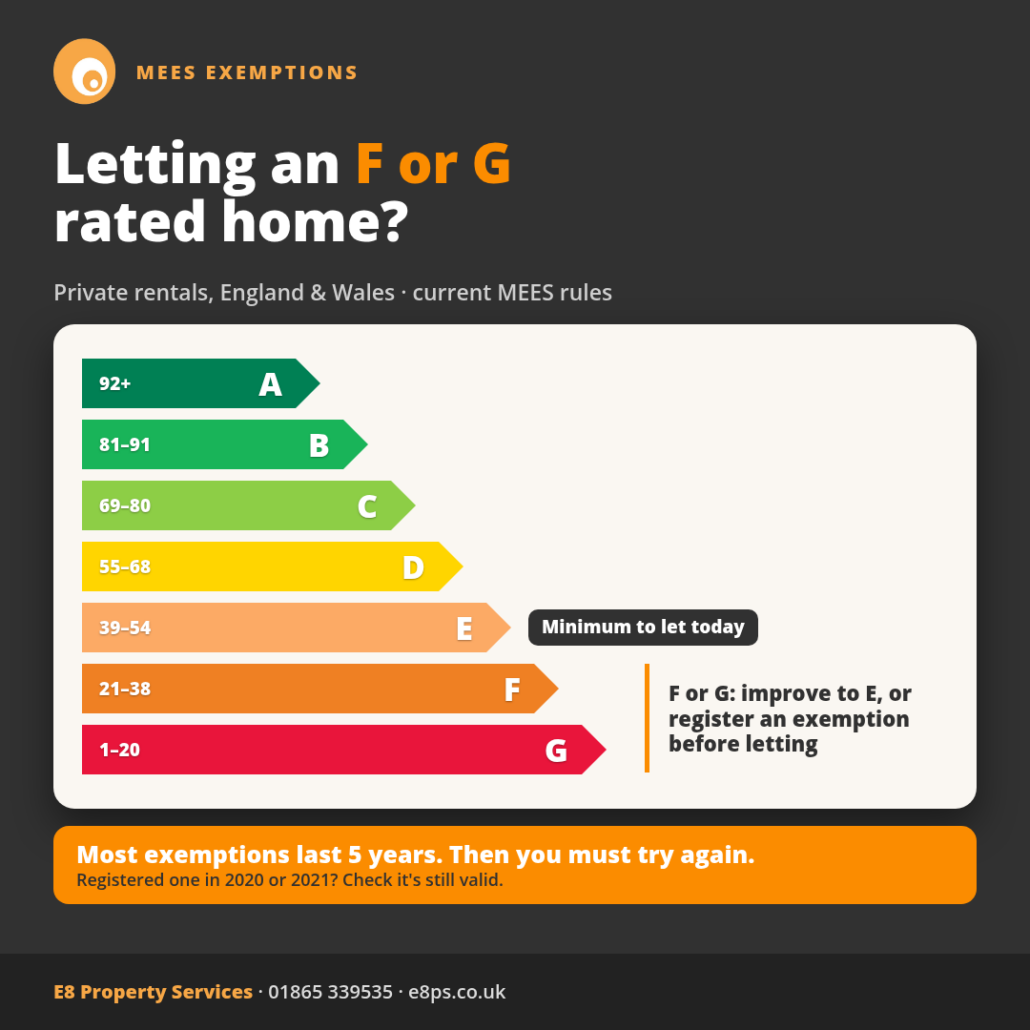
The Minimum Energy Efficiency Standard (MEES) Regulations apply to domestic private rented homes in England and Wales that are let on an assured, regulated or domestic agricultural tenancy and are legally required to have an EPC. Since 1 April 2020, landlords cannot let, or continue to let, a covered property with an EPC rating of F or G unless a valid exemption is in place.
In practice that leaves two routes for an F or G property: improve it to at least E, or register an exemption on the PRS Exemptions Register. An exemption applies only from the date it is registered.
The cost cap
At present, landlords are not required to spend more than £3,500 including VAT on energy efficiency improvements. If a property cannot reach E within that amount, you make all the improvements you can up to the cap, then register an “all improvements made” exemption. Money spent on energy efficiency work since 1 October 2017 can count towards the cap.
The main exemptions
GOV.UK lists six exemptions for domestic lets:
- All relevant improvements made. The property is still below E after improvements up to the cost cap, or there are none that can be made.
- High cost. Even the cheapest recommended measure would cost more than £3,500 including VAT. You need three quotes from qualified installers to show it.
- Wall insulation. The only relevant improvements are wall insulation measures, and written expert advice says they would harm the fabric or structure of the building.
- Third-party consent. A recommended measure needs consent from someone else, such as a tenant, freeholder, mortgage lender or the planning department, and it has been refused despite your best efforts. In Oxfordshire’s conservation areas, planning consent is a common sticking point.
- Property devaluation. An independent RICS-registered valuer reports that the improvements would reduce the property’s value by more than 5%.
- Recently becoming a landlord. A temporary six-month exemption in certain circumstances.
Each one needs supporting evidence uploaded to the register.
Exemptions don’t last forever
This is the point many landlords miss. Most exemptions last five years. The third-party consent exemption lasts five years, or, where tenant consent was the issue, until that tenancy ends. The new-landlord exemption lasts six months. When an exemption expires, you have to try again to improve the property to E, and register a further exemption only if it still isn’t possible.
So if you registered an exemption in 2020 or 2021, it is worth checking now whether it is still valid. Something unaffordable then may be possible today.
What about EPC C by 2030?
The government has said it aims for as many privately rented homes as possible to reach EPC C or equivalent by 2030, and GOV.UK says it is exploring policy design options following its 2026 consultation. Until the detail is set out, including how exemptions would work under a higher standard, treat anything beyond the current E requirement as proposed rather than law, and check GOV.UK for updates.
Penalties
Local authorities enforce MEES. They can serve a compliance notice asking for the EPC, tenancy agreement and details of improvements, and issue penalties of up to £5,000 per property in total. False or misleading information on the Exemptions Register can itself be penalised.
Where E8 can help
An exemption starts with an accurate EPC. Our Domestic Energy Assessors, accredited by Elmhurst Energy and ECMK, have been carrying out EPCs across Oxfordshire since 2009. If a property falls short, our MEES Report service looks at the most straightforward route to the required standard, so you can see whether improvement is realistic before deciding whether an exemption applies. We can’t give legal advice, and whether a property qualifies for an exemption is for the landlord to establish, but we can make sure you start with the right information.
FAQ
Can I let a property rated F or G?
Only if it is not covered by the MEES Regulations, or a valid exemption has been registered on the PRS Exemptions Register before you let it.
How long does a MEES exemption last?
Most last five years. A tenant-consent exemption can end when the tenancy ends, and the new-landlord exemption lasts six months.
Do I need to spend £3,500 even if a cheaper fix gets me to E?
No. If the property can reach E for less, that is all you need to spend.
Does a listed building need an EPC?
Not always. GOV.UK says listed buildings may not need an EPC if the work needed to meet minimum standards would unacceptably alter their character or appearance. Check with your local council’s conservation officer.
Can E8 register an exemption for me?
The landlord registers the exemption and is responsible for meeting the criteria. We provide the EPC and MEES advice that inform the decision.
To book an EPC or ask about a MEES Report, call 01865 339535 or visit e8ps.co.uk.
