
Happy Tenants, Happy Landlords: Why Warmer Homes Matter for Oxfordshire Landlords
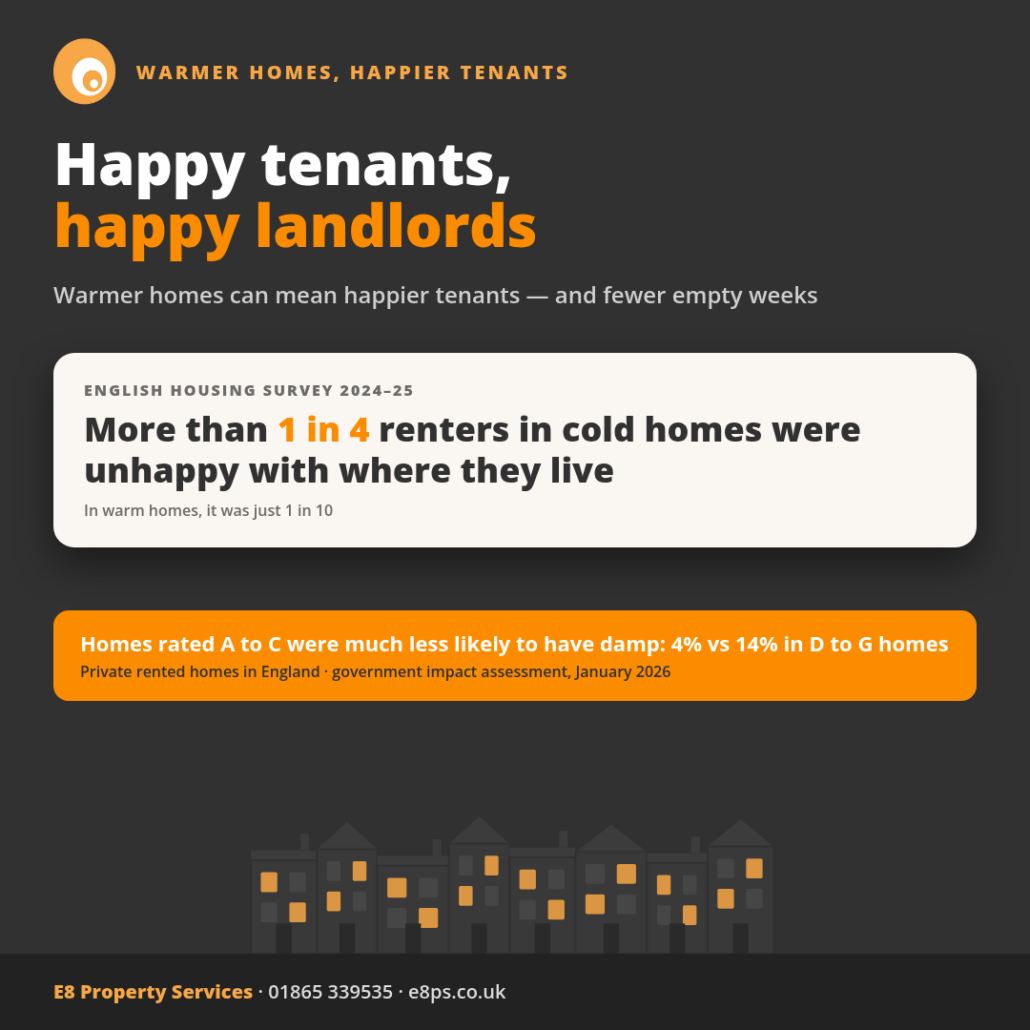
When a rental feels warm and comfortable, tenants notice. For Oxfordshire landlords, that is good for the people living there, and it can also be good for the income the property earns.
In short: happy tenants, happy landlords.
Why warmth matters to tenant happiness
The latest English Housing Survey shows a clear link between warmth and happiness at home. More than one in four private renters who couldn’t keep their home warm in winter were unhappy with where they lived (28%). Among renters whose homes stayed warm, it was only one in ten (10%). And cold homes are more common in renting: about one in five private renters (21%) couldn’t keep comfortably warm, compared with fewer than one in ten owner-occupiers (8%).
Tenants who cannot keep warm are much more likely to be unhappy with their home
Share of households unhappy with their accommodation (the survey’s word is “dissatisfied”), by whether they could keep comfortably warm in their living room in winter. Figures: all households 23% vs 5%; private renters 28% vs 10%; owner-occupiers 11% vs 2%.
Source: English Housing Survey 2024 to 2025: perceptions and impacts of housing quality, Figure 2.8 and Annex Table 2.10, published 9 July 2026. This shows dissatisfaction, not a proven extra length of tenancy. View the source on GOV.UK.
Happier tenants are more likely to want to stay, which can mean fewer moves and fewer empty weeks. Official figures do not yet show a proven number of extra months or years stayed in the private rented sector, but cold homes and unhappy tenants clearly go together. Private renters already move more often than other tenures, staying an average of 4.7 years, and every ending tenancy brings a void and a re-let.
Better EPCs, warmer and more comfortable homes
A better energy rating is a practical route to a warmer, more comfortable rental. A government impact assessment found that only 4% of private rented homes rated A to C had damp present, compared with 14% of those rated D to G. Under the preferred design for a higher future standard, tenants in upgraded properties are projected to save an average of £210 a year on energy bills by 2030.
Better-rated rentals are much less likely to have damp
Share of private rented homes in England with damp present, by Energy Efficiency Rating band. Homes rated A to C were much less likely to have damp than those rated D to G. This is an association, not a guarantee for every property.
Average projected energy-bill saving by 2030 for tenants in upgraded private rented homes, under the government’s preferred design for a higher future standard.
Source: Department for Energy Security and Net Zero, Improving the energy performance of privately rented homes: impact assessment, 16 January 2026 (updated 21 January 2026). The £210 figure is based on projected 2030 energy prices, adjusted to 2025 pounds. Read the impact assessment.
That does not mean every higher-rated home is automatically dry and warm, but it does show a clear comfort divide by energy rating. A better EPC is one way to work towards a home that is nicer to live in, and that tenants are more likely to want to stay in.
What an empty period really costs
Even a short gap between tenants is expensive here. Official average private rents in October 2026 ranged from £1,329 a month in Cherwell to £1,956 in Oxford. Four weeks empty at the Oxford average is about £1,806 of lost rent, before re-letting costs. The calculator includes the other Oxfordshire district averages. Use the calculator below with your own figures; the void weeks and re-letting costs are examples you can change, not a forecast.
What could a void period cost in lost rent?
Choose an area to start from the official average private rent for October 2026, or type your own monthly rent. The four-week void and any re-letting cost are examples — change them to match your last re-let. This does not estimate how long a property will be empty, and it does not claim a better EPC shortens a private-rental void by a set amount.
Rent defaults are official average monthly private rents for October 2026 from the ONS Price Index of Private Rents (local pages updated 18 November 2026). Weekly rent is calculated as monthly rent × 12 ÷ 52. Oxford: ONS Oxford rents. Other Oxfordshire districts and the South East / UK averages are taken from the same ONS local housing pages and the November 2026 private rent bulletin.
There is no robust official figure for how much shorter private-rental voids are in higher-EPC homes. A social-landlord study covering more than 500,000 homes found band B properties were void for 31% less time than those in bands E and F; treat that as context only, not a private-rental result.
Planning towards a possible EPC C
Today, the legal minimum for a domestic private rental in England and Wales that needs an EPC is still band E, unless a valid exemption is registered.
The government has said it intends to raise that minimum to the equivalent of EPC C from 1 October 2030, or require a valid exemption. That was confirmed in its 21 January 2026 response, with a proposed maximum required investment of £10,000 per property and a transitional rule for homes already rated C on an EPC issued before 1 October 2029. The regulations still have to be laid, so treat C as confirmed policy rather than current law. Getting ahead of that date is about giving tenants a warmer home, with a clearer view of the works and costs, in good time.
How E8 can help
Our Domestic Energy Assessors, accredited by Elmhurst Energy and ECMK, have been carrying out EPCs across Oxfordshire since 2009. If you want a plan rather than just a rating, our MEES Report service visits the property, produces a draft EPC, then remodels the data to find the most cost-effective and least disruptive route towards band E or a potential future band C. You receive a step-by-step guide, and after the works we return to complete a final EPC. We cannot give legal advice or promise a particular rating, but we can make sure your decisions start from an accurate assessment. For a broader retrofit plan, we also work alongside Cosy Homes Oxfordshire on Whole House Plans.
FAQ
Is EPC C already the legal minimum for rentals?
No. The legal minimum today is still E. The move to the equivalent of C from 1 October 2030 is confirmed government policy, but the regulations are not yet in force.
Do tenants in warmer homes stay longer?
Happier tenants are more likely to want to stay, which can mean fewer moves and fewer voids. We do not have a verified private-rental figure for how many extra months or years they stay.
Does a better EPC make a home more comfortable?
It is a practical starting point. Official analysis found that private rented homes rated A to C were much less likely to have damp present than those rated D to G, and tenants in upgraded properties are projected to save an average of £210 a year on energy bills by 2030.
What should I do first?
Check each property's current EPC and expiry date, then book a fresh assessment if it is old or below C.
To book an EPC or ask about a MEES Report, call 01865 339535 or visit e8ps.co.uk.
Sources
- English Housing Survey 2024 to 2025: perceptions and impacts of housing quality, Ministry of Housing, Communities and Local Government, published 9 July 2026. https://www.gov.uk/government/statistics/english-housing-survey-2024-to-2025-perceptions-and-impacts-of-housing-quality/english-housing-survey-2024-to-2025-perceptions-and-impacts-of-housing-quality
- English Housing Survey 2024-25, Chapter 3: Housing history and future housing (private renters’ average length of residence, 4.7 years; Annex Table 3.6). https://www.gov.uk/government/statistics/chapters-for-english-housing-survey-2024-to-2025-headline-findings-on-demographics-and-household-resilience/chapter-3-housing-history-and-future-housing
- Improving the energy performance of privately rented homes: government response, Department for Energy Security and Net Zero, 21 January 2026. https://www.gov.uk/government/consultations/improving-the-energy-performance-of-privately-rented-homes-2025-update
- Improving the energy performance of privately rented homes: impact assessment, DESNZ, 16 January 2026 (updated 21 January 2026). Damp by EPC band (4% of PRS A–C vs 14% of PRS D–G) and the £210 average annual bill saving for tenants in upgraded properties by 2030. https://www.gov.uk/government/consultations/improving-the-energy-performance-of-privately-rented-homes-2025-update/outcome/improving-the-energy-performance-of-privately-rented-homes-impact-assessment-html
- Office for National Statistics, Price Index of Private Rents, average monthly rents for October 2026 (local pages updated 18 November 2026): Oxford £1,956; South Oxfordshire £1,430; Vale of White Horse £1,385; West Oxfordshire £1,339; Cherwell £1,329; South East £1,448; UK £1,411. Starting points: https://www.ons.gov.uk/visualisations/housingpriceslocal/E07000178/ and https://www.ons.gov.uk/economy/inflationandpriceindices/bulletins/privaterentandhousepricesuk/november2026
- Sustainable Homes, cited in NHMF best-practice case study, “Touching the voids” research with 25 social landlords managing over 500,000 homes. https://www.nhmf.co.uk/files/dmfile/NHMF-Case-study-fuel-saving-sustainable-homes.pdf
- E8 Property Services, Energy Performance Certificates and MEES Report service pages. https://www.e8ps.co.uk/epc/ and https://www.e8ps.co.uk/mees-report/
